01
Foundational Mathematical Concepts
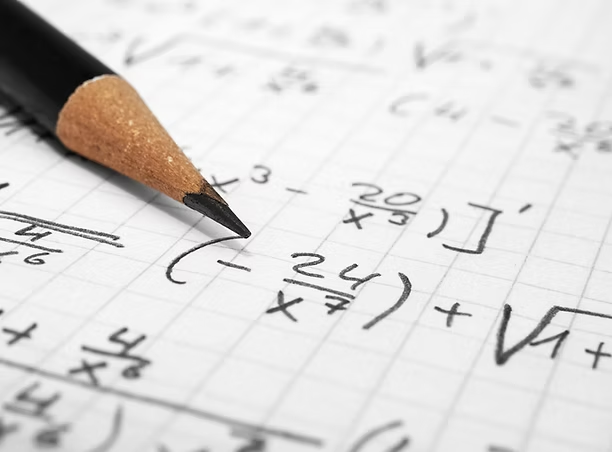
Students are introduced to the core principles of number theory and operations, establishing a solid base in handling whole numbers, fractions, decimals, and percentages.
Number systems, algebra, geometry, data and real-world problem solving for Grades 6–8.
The Junior High Mathematics program at Wise Owl encompasses a comprehensive curriculum designed to develop essential mathematical skills across various key concepts.
For Grades 6 and 7, the program begins with the Number System unit, emphasizing number theory and operations with whole numbers, fractions, decimals, and percentages. Algebra follows, introducing variables, expressions, and equations, progressing from simple one-step problems to more complex multi-step situations. Geometry and Measurement explore geometric shapes, area, volume, and transformations, while Data Management and Probability focus on analyzing data and understanding probability.
The Mathematical Connections and Applications unit ties these concepts together, applying them to real-world problems and interdisciplinary tasks. For Grades 7 and 8, the curriculum expands to include advanced topics such as operations with rational numbers, algebraic expressions, ratios, proportions, and detailed geometric measurements, ensuring a deep, practical understanding of mathematics that prepares students for future academic challenges.
Students are introduced to the core principles of number theory and operations, establishing a solid base in handling whole numbers, fractions, decimals, and percentages.
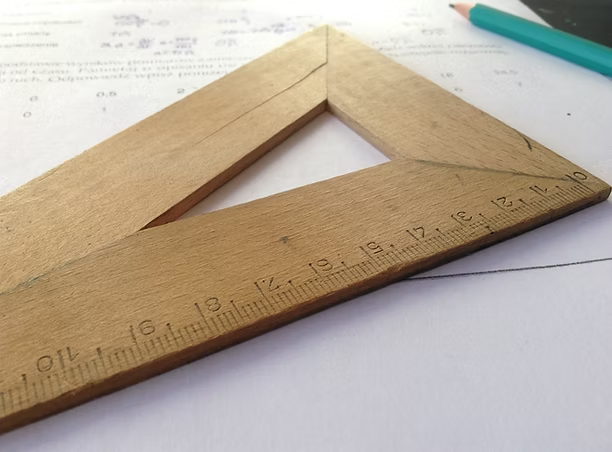
Students tackle multi-step algebraic equations and inequalities, simplify expressions, and solve linear relationships using graphs, tables, and equations.
In geometry, they progress from basic measurements to advanced transformations, including translations, rotations, and reflections, enhancing their problem-solving skills for advanced studies.

Designed to connect classroom learning with everyday scenarios, demonstrating the practical relevance of math concepts.
Students apply their knowledge to real-world problems such as budgeting, architecture, and data analysis. Through engaging projects and interdisciplinary tasks, they see how mathematics influences technology, science, and the arts.
See our Junior High classrooms, meet our educators and picture your child learning here. Monday–Saturday tours for the 2026–2027 school year.